
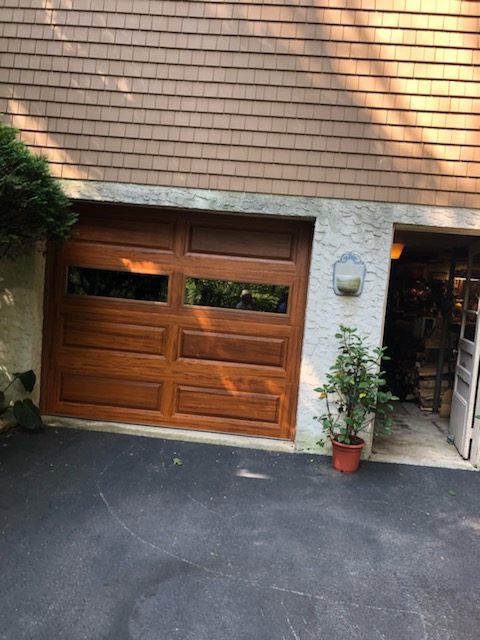
Your car is ready to go, but the overhead door stays shut. Before you press the remote again, look at the door from a safe distance: is it level and still, or has a cable gone slack or one side has begun to rise? That difference decides whether you can make a basic power check or need to leave the entire system alone.
We’re Howell Door Company, a garage door service company based in West Chester, Pennsylvania. If your car is stuck inside, first use another safe exit if you have one. Then work through the observations below without standing beneath the door, reaching into its hardware, or trying to make a damaged door move.
Safety First: If the door is crooked, unusually heavy, partly open and unstable, or shows a broken spring, loose or frayed cable, displaced roller, or damaged track, do not use the garage door until a technician has inspected it. Keep children and pets clear.
Do not pull the emergency release, lift the door, change opener force settings, or touch springs, cables, drums, or bottom brackets. The Door & Access Systems Manufacturers Association (DASMA) warns that spring-connected cables and bottom brackets can be dangerous.
Start With the Access Problem, Not the Opener
A stuck car is not always an immediate danger. For a medical emergency, fire, or unsafe garage, use a safe exit and contact emergency services. Otherwise, arrange another ride while the door remains still.
If you cannot leave safely, explain that when you seek help. An urgent appointment is not permission to force a heavy door. Tell the repair company whether the vehicle is trapped and the door is fully closed or partly open.
| What You Notice From a Safe Position | Possible Path | Next Move |
| Door is level and closed; wall button and remote do nothing | Power or control issue is possible | Check accessible power indicators and a known safe household outlet; do not open electrical housings. |
| Wall button works but one remote does not | Remote battery, range, or control issue is possible | Use the working wall control only if the door travels normally and no damage signs appear. |
| Opener runs or clicks, but the door barely moves | Door, drive, spring, or opener fault is possible | Stop commands and arrange diagnosis; do not assume the motor is the only problem. |
| One edge rises, a cable hangs loose, a spring has a gap, or the door looks crooked | A mechanical hazard is possible | Do not use the garage door until a technician has inspected it. |
| Door moves normally once, then fails again | An intermittent fault is possible | Do not depend on the next cycle to get back in; request an inspection. |
This table sorts risk, not parts. An opener sound does not prove the door is safe; DASMA says a heavy door may be out of balance and a stronger opener is not the answer.
1. Is Power Reaching the Opener?
A silent opener is a reason to check power, not a reason to handle the door. From the floor, look for a visible opener light or indicator, and see whether other ordinary garage lights work. If there was a neighborhood outage, check your utility’s outage information rather than guessing that the opener has failed.
If the opener plugs into an accessible outlet, check whether the plug is visibly seated without climbing or touching wiring. You can test a separate, reachable outlet with a working device. For a tripped breaker, damaged outlet, burning smell, or recurring fault, seek an electrical professional or opener technician; do not work inside the opener or panel.
No power does not prove the door is sound. Some openers have battery backup; check your model’s manual rather than assuming yours does.
If power returns: Only consider one ordinary command if the door is fully closed, level, and free of the warning signs above. Watch the whole travel from a clear position, as DASMA recommends for powered door operation. If it strains, rises unevenly, stops unexpectedly, or makes a new harsh noise, stop using it and request garage door repair.
2. Does the Wall Button Work When the Remote Does Not?
A working wall control with a failed handheld remote narrows the question to the remote or its connection to the opener. Look for an obvious weak-battery indication and consult the manual for your model. Try a spare remote if you already have one, but do not keep cycling the door to experiment.
If the wall button opens the door smoothly, wait until it is fully open and still before driving out. Keep people clear. Plan how you will reopen and secure it when you return.
A failed wall button does not prove a failed circuit board. Power, controls, or the door itself may be at fault. Do not open the housing, splice wiring, or bypass a safety feature; request garage door opener service instead.
3. The Motor Runs, but the Door Stays Down
This is the point where another press can make the situation worse. If the opener hums, clicks, or runs while the door remains shut, stop sending commands. From a safe position, note whether a spring above the door has a visible gap, whether a cable appears loose, or whether the door started to lift on one side.
A broken spring can leave the door much harder to move than it looks. DASMA advises professional inspection and replacement of broken springs, and says spring-related repairs belong with trained technicians. Do not use the garage door until a technician has inspected it; do not disconnect the opener and attempt to lift it to get the car out (DASMA garage door system safety tips).
A loose cable or shifted drum is also a stop. Cables connect to a high-tension system, and only a trained technician should handle bottom brackets. Describe the symptom and request spring replacement assessment or cable repair as indicated by inspection.
The sound may also come from a failed opener drive component. That is why the service call needs a diagnosis of both the door and the operator. A replacement opener will not solve an unsafe, out-of-balance door, as DASMA explains.
4. The Door Starts Up, Then Stops or Tilts
Treat uneven movement as a mechanical warning even if the car is only inches from getting out. Do not stand under a partly open door, drive beneath it, or ask someone to hold it while you move the vehicle. If a roller leaves the track, the door twists, or a cable hangs differently on the two sides, stop all operation.
A level-looking door that stops at the same point could still have an obstruction, travel problem, or hardware fault. Observe it from a clear position; do not reach into the track or push on a panel. If it has already stopped, additional opener cycles are not a safe diagnostic method.
A technician can inspect door balance, tracks, springs, cables, and opener behavior together. Tell the dispatcher if the door is suspended or blocking a pedestrian route.
5. What If the Door Is Locked or Something Is in Its Path?
A visible slide lock or object against the door may explain why it will not rise. Look without operating the opener. Clear an accessible object only if you need not touch the door or hardware.
Do not repeatedly run the opener against a lock or obstruction. If the lock appears engaged, consult the door and opener manuals before taking any action; if you cannot identify the setup confidently, leave it alone and call. A jammed lock, bent track, or bent panel changes this from a simple access check to a repair.
If a level, undamaged door still resists its normal command after the obstacle is gone, stop. A clear path does not rule out a weak spring, binding track, or opener problem.
Should You Pull the Red Emergency Release?
Not as a reflex when a car is trapped. The release separates the opener from the door, but it does not make a broken spring, bad cable, crooked door, or unstable partly open door safe. On a damaged or unbalanced system, taking away the opener’s connection can create an uncontrolled movement risk.
Even with a level, closed door, manual operation depends on its condition and model-specific instructions. This is not a release or lifting guide. If you cannot verify the system is sound, leave it closed and arrange help; DASMA directs owners to their manuals and trained technicians for dangerous door-system work.
If you already pulled the release and the door became heavy, crooked, or unpredictable, keep it still. Do not try to reconnect it by running the motor or forcing the door. Tell the technician its current position and what happened immediately before you stopped.
Give the Technician a Useful Dispatch Picture
Call from a safe spot with the door stationary. Give these details without trying to diagnose the part:
- Is the door fully closed, fully open, or stuck partway? Is it level?
- Is the car inside, and is there another safe entrance or exit?
- Did the wall button, one remote, or both fail? Is the opener silent, clicking, or running?
- Did you hear a bang, see a spring gap or loose cable, or notice a displaced roller?
- Was there a power outage, and did anything change after power returned?
- Did the door move unevenly or stop at a particular point? Have you already pulled the release?
A photo from a safe standing position may help. Never enter the travel path, climb, or touch a cable for a better image. If the door is unstable, people’s safety matters more than a photo.
In Chester, Montgomery, and Delaware counties, give your town and callback number. Confirm coverage and appointment timing on the call, especially if you need a ride or must arrange access through a separate door.
Repair the Failure, Not the Entire Door by Default
Being unable to leave does not mean you need a new door. If the problem is a remote battery or a one-time power interruption and the system subsequently operates normally, a major replacement may not be necessary. If the door is damaged or repeatedly fails, an inspection should separate the specific failure from the condition of the rest of the system.
Ask what is wrong with the door, what is wrong with the opener, and which repair restores safe operation. If both have issues, request separate explanations. If replacement is recommended, ask what a targeted repair would and would not fix.
Before authorizing work, request a written scope and total price. Price changes with the diagnosed component, door weight and configuration, parts needed, accessibility, and whether other damaged hardware must be repaired. A remote failure is not priced like a spring-and-cable repair, and no honest quote can be inferred merely from “the car is stuck.”
Do not buy a stronger opener to compensate for a heavy door. DASMA says openers are designed for properly balanced doors. If the door is the fault, repair that system first and compare any opener work only after the cause is known (DASMA opener guidance).
Frequently Asked Questions
Can I Drive Under a Garage Door That Is Only Partway Open?
No. Do not drive or walk under a partly open door that stopped unexpectedly or looks unstable. Keep the area clear and tell the repair company exactly where the door stopped.
Can I Open a Garage Door With a Broken Spring to Get My Car Out?
Do not use the garage door until a technician has inspected it. Do not pull the release or attempt to lift it by hand. DASMA identifies broken springs and connected high-tension hardware as injury hazards.
Why Does the Opener Make Noise but Not Lift the Door?
A sound alone cannot distinguish a door problem from an opener problem. Stop repeating the command, look for visible hazards from a safe position, and request an inspection. A replacement motor is not automatically the answer.
What if the Remote Fails but the Wall Button Works?
A remote battery or control issue is possible. If the door is level and runs normally from the wall control, check the specific opener manual and a spare remote. Do not keep experimenting if the door strains or moves unevenly.
What if the Power Is Out and the Car Is Inside?
Use another safe exit and arrange transportation if possible. Check whether your exact opener has a working battery backup, but do not assume it does. Do not use the manual release on a door whose balance or hardware condition you cannot verify.
How Much Will an Emergency Garage Door Repair Cost?
It depends on the diagnosis, parts, door configuration, access, and scope of work. Ask for a written total and whether the quoted work addresses the door, opener, or both. An inspection is more useful than a price based only on the stuck-car symptom.
Should I Replace the Opener or the Whole Door?
Not automatically. A remote, power, or repairable component fault may not justify either replacement. Ask the technician to explain what can be repaired, what remains unsafe, and the separate costs before deciding.
Get Help Without Forcing the Door
A trapped vehicle is a real disruption, but the next safe move may be a ride and a repair appointment, not another opener cycle. Keep the door still if any warning signs appear, and tell the service team whether the car is trapped and whether anyone is unable to exit safely.
Howell Door Company handles garage door, spring, cable, and opener service from West Chester for customers in Chester, Montgomery, and Delaware counties. Call (484) 266-0891 to describe the symptom and ask about the next available repair appointment and scope of inspection. You can make the call without guessing which part failed.