
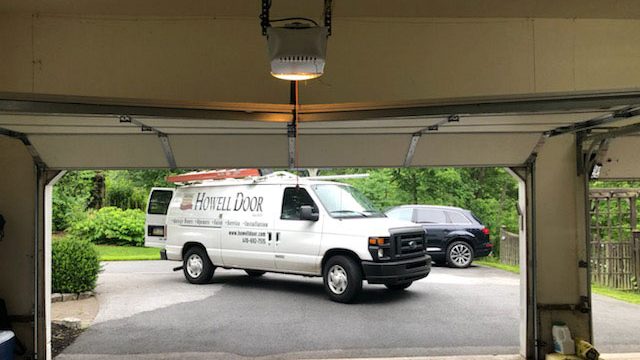
Your garage door still opens, but it takes longer than you remember. That is a clue, not a diagnosis. The opener might be responding to resistance in the door, the door might be stuck at the floor, or the operator itself might need service. A cold morning makes the change easier to notice; it does not prove the temperature caused a particular part to fail.
Howell Door Company is based in West Chester, Pennsylvania, and serves Chester, Montgomery, and Delaware counties. If you’re asking, “Why is my garage door opening so slowly?” start by noting where the delay happens: before the door moves, at the first inch, at one point along the tracks, or throughout the trip.
Those observations help separate a door problem from an opener problem without treating either as safe to force.
Safety First: Stop Before Any Check. If the door is crooked, off its track, unusually heavy, hanging unevenly, or visibly damaged at a spring, cable, drum, or bottom bracket, do not use the garage door until a trained technician has inspected it. Do not pull the emergency release, lift the door by hand, change opener force or speed, or touch tensioned hardware. A visibly broken spring or cable is not a lubrication problem.
The Door & Access Systems Manufacturers Association (DASMA) maintenance guide warns that spring-related components are under high tension; Genie likewise says not to operate a jammed door or one with a broken spring.
First, Pinpoint the Kind of Slow
Watch from a safe position during one normal opening attempt only if the door looks intact, the opening is clear, and no warning sign above is present. Keep people and pets away. Stop at once if it strains, jerks, tilts, or sounds wrong. You are observing, not trying repeated cycles to make it work.
| What You Notice | Possible Direction for Diagnosis | What You Can Safely Do |
| Opener responds, but the bottom edge seems stuck to the floor | Moisture or ice may be bonding the bottom seal | Do not force it; inspect the threshold visually |
| Door moves, then catches or rattles at a particular spot | Roller, hinge, or track friction may be involved | Look from a safe distance; leave hardware alone |
| Whole door struggles, rises unevenly, or looks heavy | Balance, spring, or cable trouble is possible | Stop using it and request professional inspection |
| Door travels smoothly but at an unfamiliar pace, or pauses before moving | The opener or its model-specific settings may need diagnosis | Note the model and symptoms; do not adjust force or speed |
These are possibilities, not a frequency ranking. A technician can evaluate the complete system before recommending an opener.
1. The Bottom Seal May Be Held at the Threshold
The first inch tells a different story from a slowdown halfway up. If the motor responds but the door remains planted at the floor, look through a window or from a clear, dry place for water, ice, or a seal visibly stuck to the threshold. Moisture at an exterior opening can freeze when the surface temperature drops; a wet threshold alone does not establish that ice is the cause.
How to check: With the door stationary, look for a visible ice line or water pooled at the bottom edge. Do not put your hand under the door or use a tool to pry at its seal. If you cannot see the bottom edge clearly, leave the cause undetermined rather than pulling harder on the door.
What to do: Keep the opener off and allow a suspected ice bond to thaw without forcing the door. Do not pour boiling water on the seal, attack it with a sharp tool, or run the opener repeatedly. Even if it releases later, check for torn rubber, a damaged retainer, or pooling water once the area is accessible and stationary. A floor-drainage or threshold problem can recur after the next wet freeze.
If that does not solve it: A door that remains difficult to move after the visible moisture is gone may have an unrelated mechanical problem. Leave a heavy or uneven door alone. Ask for a garage door repair assessment rather than treating every cold-day delay as a frozen seal.
Around West Chester, the useful weather clue is whether your particular threshold got wet before it froze.
2. Rollers, Hinges, or Tracks May Be Adding Drag
If the door leaves the floor but hesitates near the same point on its way up, pay attention to the path of the moving sections. Rollers travel in tracks while hinges connect the sections. Visible wear, debris, a shifted track, or a damaged roller can change how freely that assembly moves. DASMA identifies rough travel as a warning that the door system may not be operating safely.
How to check: With the door stopped, look for obvious debris from a safe place, without reaching into the track. Note whether the sound and hesitation happen at the same height. Do not infer that a silent track is healthy or that every squeak is a failed roller. If a roller is out of its track, a track is bent, or the door is crooked, stop using it.
What to do: Remove only loose debris that is safely reachable while the door is fully stationary and without touching any brackets or moving parts. Then leave mechanical diagnosis to a technician if the hesitation persists. A professional can distinguish a worn roller or hinge from a track that is out of position, a damaged section, or another load on the opener.
The lubricant question deserves care. The association’s maintenance guide says hinges and rollers may need periodic lubrication and directs owners to the model manual. It does not say to pour grease into tracks or assume cold has hardened your lubricant. Old, gummy material merits inspection, not a blind application of more product.
If that does not solve it: Report the exact height and noise to Howell when requesting service. A clear symptom description is more helpful than ordering “a new motor” before anyone checks the door. If the door is off-track or a cable looks loose, the safety stop applies immediately.
3. The Counterbalance May No Longer Be Helping Enough
An automatic opener is not supposed to supply all the lifting effort. The springs counterbalance the door; cables and drums are part of the lifting system. DASMA explains that an opener is designed for a properly balanced door, not as a substitute for a weak or out-of-balance one. The opener may sound as if it is struggling when the resistance actually starts elsewhere.
How to check: Look only for visible signs from a safe distance: a gap in a spring, a slack or frayed cable, one side rising ahead of the other, or a door that stops abruptly. Do not pull the release to perform a balance test on a suspect door. A disconnected, poorly balanced door can move unexpectedly, and the hazard does not disappear because the motor is off.
A temperature drop and a spring problem can coincide without proving causation. Springs wear and break in service, as the association explains. Cold air alone is not a diagnosis.
What to do: Do not use the garage door until a trained technician has inspected it if it is heavy, crooked, uneven, or has visible spring or cable damage. Howell has dedicated spring repair and cable repair information, but these are service issues, not homeowner adjustments. Never loosen a bottom bracket, touch a drum, or try to wind or stretch a spring.
If the spring and cable system checks out: The technician can look at travel resistance and opener behavior. A stronger opener does not correct a balance problem.
4. The Opener May Be Responding to Resistance or Have Its Own Fault
Sometimes the door and its hardware are sound, but the powered opener starts late, moves at an unfamiliar pace, or stops partway. Possible explanations include a problem in the drive assembly, a control fault, or a model-specific operating feature. Some units have monitored operation that responds to changing load; Genie describes this on some of its newer models. That does not mean every slow Genie, LiftMaster, or other opener is reporting the same fault.
How to check: Record whether the wall control and remote behave differently, whether the motor starts before the door moves, and whether any indicator shows a code. Read the label on the power unit from a safe position, and note the exact brand and model if visible. DASMA recommends using the owner manuals for the specific door and opener, not applying one manufacturer’s light pattern to another.
What to do: Keep the full opening in sight during ordinary operation and follow your model manual for noninvasive owner checks. Do not open the motor housing, probe wiring, change travel limits, boost force, or alter speed to push past resistance. If you see a code, save the exact pattern rather than guessing what it means. A technician can determine whether the door is dragging or the opener itself needs work.
If that does not solve it: Ask Howell about garage door opener service. Logic-board and electrical work are not do-it-yourself work; mistakes can create shock risk or undermine safety operation. Check door balance and movement before considering opener replacement.
What Should You Tell a Technician?
A useful service request does not need a perfect diagnosis. Tell the technician when you first noticed the change, whether it happens only after wet or freezing conditions, and where in the travel it slows. Mention any new scrape, bang, flashing code, crooked section, or visible damage. If there is a spring, cable, or off-track warning, say that first and leave the door unused.
A phone video helps only if you can take it safely during normal operation. Never run a damaged door just to film it. Have the opener model ready if possible.
The question is where resistance starts: threshold, travel path, counterbalance, or operator. Answering it helps avoid paying for the wrong part without attempting dangerous checks.
Is This a Repair or a Replacement, and What Might It Cost?
The bill depends on the finding, not just the symptom. A threshold or seal issue, a roller or hinge repair, a spring or cable job, and an opener diagnosis require different parts and labor. Door size, access, hardware condition, model compatibility, and whether more than one defect is present also change the scope. A technician should explain the cause and the proposed work before you decide.
A single price would be misleading across four very different problems. Ask what the diagnostic visit costs, whether its fee applies to a repair, and for a written breakdown of parts, labor, and any replacement option.
Do not replace a serviceable opener for one slow morning. Do not dismiss repeated slow travel as “just the weather” if the door is crooked or struggling.
Frequently Asked Questions
Why Is My Garage Door Opening Slowly Only in the Morning?
Note whether the bottom seal appears wet or stuck at the first inch, and whether the issue disappears after the threshold dries or warms. That pattern suggests something worth inspecting at the floor, but does not prove ice is the only problem. If the door strains, tilts, or has damaged hardware, stop using it instead of repeating the morning test.
Can Cold Weather Damage My Garage Door Opener?
A slow opening during cold weather does not by itself establish opener damage. The door may face resistance at the seal, along the track, or in its counterbalance, and an opener may be reacting to that load. Have the complete door-and-opener system assessed if the symptom persists.
Should I Increase the Opener’s Force or Speed?
No. A changed setting can mask resistance and compromise safe operation. DASMA recommends trained help for opener sensitivity work. A technician should identify why the door is slow before making a model-appropriate setting decision.
Is It Safe to Pull the Emergency Release and Lift a Slow Door?
Not when a spring, cable, drum, track, or balance problem is suspected. A heavy or unbalanced door can move unexpectedly after disconnecting. Do not use the garage door until a trained technician has inspected it if you see damage or uneven movement.
Should I Spray Lubricant Into the Tracks?
Do not use lubricant as a blanket fix for slow opening. DASMA advises consulting the door and opener manuals for model-specific upkeep. A bent track, displaced roller, or failing counterbalance needs diagnosis, not more spray.
How Much Does Slow Garage Door Repair Cost?
It depends on whether the issue is the threshold, moving hardware, spring or cable system, or opener. Ask about the diagnostic fee and get an itemized estimate before approving work.
Do I Need a New Opener if the Door Is Slow?
Not automatically. DASMA says a more powerful opener is not the solution to an out-of-balance door. Rule out door resistance and safety issues first, then compare an opener repair with replacement if the operator itself is faulty.
Get the Cause Identified Before You Buy a Fix
Howell Door Company serves homeowners from West Chester across Chester, Montgomery, and Delaware counties. Tell the team where the door slows and whether you see water at the seal, a catch along the tracks, uneven travel, or an opener code. That gives the conversation a useful starting point without asking you to diagnose a tensioned system.
For a slow or unsafe garage door, call Howell at (484) 266-0891 to discuss an inspection and request the diagnostic fee and repair options. If a spring or cable is damaged, or the door is crooked or unusually heavy, leave it unused until a trained technician has inspected it.